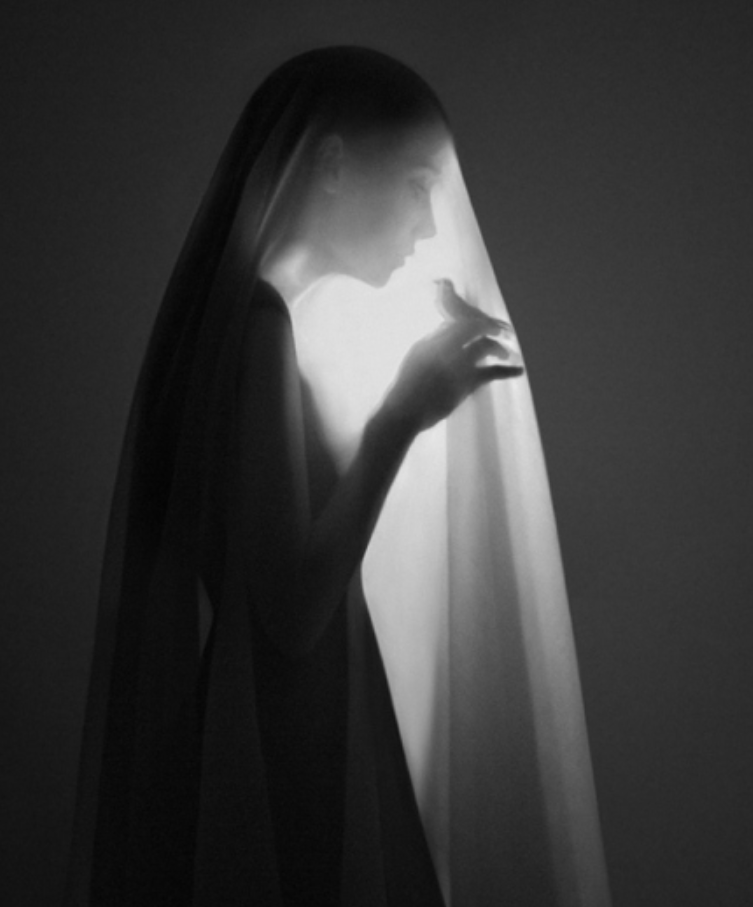
Conceptual photography allows us to move beyond simply capturing a moment and instead conveys ideas, emotions and a deeper narrative. In the work of Hungarian photographic artist Noell S. Oszvald we see exactly this: a body of black‑and‑white self‑portraits that invite the viewer to engage, interpret and feel. Her images don’t spell out a story so much as create a space for one to emerge.
Oszvald’s approach reflects a keen desire to strip away distraction. By choosing monochrome she creates a visual clarity that focuses attention on mood and form rather than colour and environment. Her photography captures what might be described as the fragile and quiet essence of life — in it we glimpse loneliness, fear, peace, security, and a delicate tension between these states. Although each viewer may bring their own interpretation, the common thread is an emotional vulnerability, a reminder that life is inherently fragile.
What makes Oszvald’s work compelling is the way she invites us into a dialogue. There is often little explanation or narrative text to guide our understanding — sometimes only a title at most. Yet that absence is deliberate: it gives viewers room to engage personally, to project their own stories and sensations onto the image. In effect, the artist provides the frame; we provide the meaning.
In her own words, Oszvald explains that she always had a strong visual impulse. Initially drawn to drawing, she nonetheless felt limited by the medium — unable to fully express what she wanted on paper. Photography, film and digital painting offered new possibilities. Through these media she could more richly realise the ideas and impressions she carried inside. Her work is rooted in personal experience, and in the interplay between inner thoughts and creative expression.
Inspiration for her conceptual pieces comes from multiple sources: books, film, music. But for Oszvald, the most important influences tend to be her own impressions and experiences — the quietly observed or intuitively felt. Those moments become seeds of idea and imagery. The result is a young but already potent portfolio of photographs that hold the viewer’s gaze and stir reflection.
The key elements that define Oszvald’s creative process are: concept‑development, thoughtful image‑making, and emotional resonance. Each photograph is more than a pretty picture — it is a visual question or suggestion. What do you feel when you see this? Why does this image linger? The work asks us to pause, look inward, and engage, rather than simply scroll by.
Because her photographs are self‑portraits, there is an additional layer of vulnerability. The artist is her own subject, and that choice adds honesty and immediacy. The viewer is confronted with not only what is shown, but how the subject is willing to reveal herself. This openness helps build a silent connection between artist and viewer — even though they may never meet. Because the photograph is laden with the artist’s own presence, it invites a connection that feels intimate.
In turning inward to express external ideas, Oszvald bridges the personal and universal. Her imagery is at once specific to her — her influences, her practice, her state of mind — and open enough to allow others to map their own feelings onto it. That duality gives the work its power.
For those of us working in photography or simply delighting in visual art, there are a few lessons to draw from this approach:
- Emphasize concept over decoration. A strong idea behind an image will often out‑last a technically perfect but conceptually shallow photograph.
- Consider limiting your palette or distracting elements. By reducing colour or background noise you help the viewer focus on what truly matters in the frame.
- Trust the viewer’s intelligence. You don’t always need to spell everything out. Leaving space for interpretation can make your work more engaging.
- Use your personal experience. The best art often grows from authenticity — your own impressions, memories, small moments of insight.
- Create images that invite time and thought. In a fast‑scroll world, work that encourages lingering stands out.
In summary, Oszvald’s photographic world is one of elegance and subtle emotional weight. The images whisper, rather than shout, and in that whisper there is an invitation: to stop, to feel, to connect. She shows us that through the medium of photography we can not only depict life, but explore its quiet edges — vulnerability, presence, fragility — and in doing so find resonance with ourselves. The art becomes not just an image but a mirror.