In late March, I embarked on a multi-day photography excursion to Snowdonia, exploring its dramatic and rugged terrain with my camera. Like many trips to North Wales, I arrived with a few predetermined locations in mind, yet allowed plenty of flexibility for spontaneous discoveries in areas I had not previously researched or visited.
On my first day, I reached the Ogwen Valley car park around midday. Eager to maximize daylight, I set off on a circular hike around the Glyderau range. While most of my shots were captured in color, certain scenes and lighting naturally lent themselves to black-and-white photography. I have grouped all monochrome images at the end, not as an afterthought, but to showcase them cohesively.
From the trail starting at Ogwen Cottage toward Llyn Idwal, I diverged onto the Cwm Bochlwyd Path, passing Llyn Bochlwyd and ascending Y Gribin. The final section of Y Gribin involved some scrambling, leading to Bwlch y Ddwy Glyder, where the views across Tryfan and the Ogwen Valley were stunning. Despite a predominantly flat afternoon light, which defined much of the trip, I adapted to the conditions, focusing on textures and forms in the landscape rather than seeking ideal sunlight.
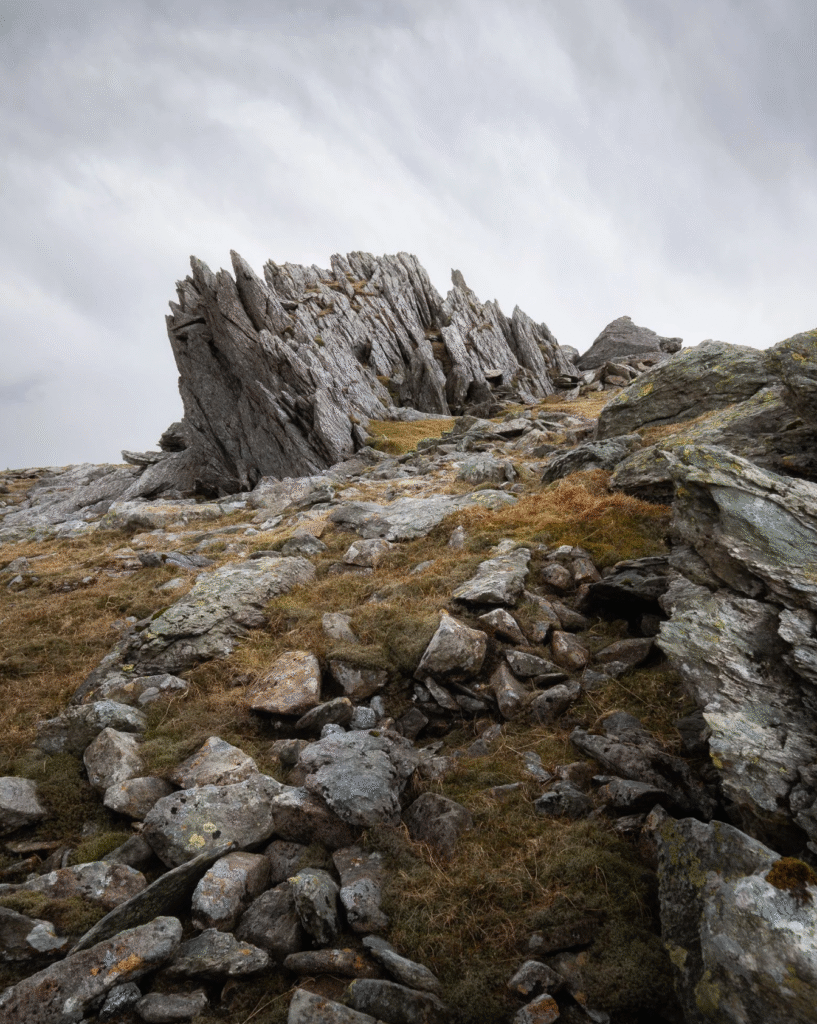
To manage the hazy distant vistas, I primarily relied on a 10–24mm wide-angle lens and used a circular polarizer to enhance clarity and contrast. The rocky formations along the path provided compelling subjects, offering opportunities to experiment with composition and perspective. For instance, as I climbed toward Glyder Fawr, I encountered a jagged rock formation that demanded a closer, low-angle approach to capture its imposing character.
Glyder Fawr, standing just over 1,000 meters, is the tallest peak in the Glyderau range. The summit area was particularly captivating, with its otherworldly rock structures offering dynamic photographic possibilities. The term “Glyder,” derived from the Welsh “Gludair” meaning “heap of stones,” perfectly describes the terrain. From this vantage point, the views extended across the Nant Peris Valley toward the Snowdon massif, where cloud formations created dramatic contrasts with the rocky foreground.
Throughout the hike, I explored multiple angles and compositions, experimenting with foreground and background elements to convey depth. Post-processing techniques such as dodging and burning were applied subtly to emphasize light and texture variations, enhancing the three-dimensional quality of the rock formations. These methods helped separate layers and drew attention to the intricate details of the landscape.
After spending significant time on Glyder Fawr, I descended toward Llyn Y Cwm and then moved on to Y Garn, the final peak before returning to Llyn Idwal. The descent was steep and challenging, with loose scree demanding careful navigation. From the summit of Y Garn and along the Devil’s Kitchen ridge, the views of Tryfan and the Ogwen Valley were breathtaking, offering new perspectives and compositions for photography.
This trip reinforced the importance of embracing variable conditions and using them creatively. Snowdonia’s landscapes, with their rugged peaks, jagged rock formations, and shifting light, reward patience and adaptability. Each vantage point offered opportunities to capture the interplay between geological forms and atmospheric conditions, highlighting the region’s dramatic natural beauty. Whether in color or monochrome, the photographs from this journey tell a story of exploration, observation, and appreciation for the intricate textures and shapes found in this remarkable corner of North Wales.